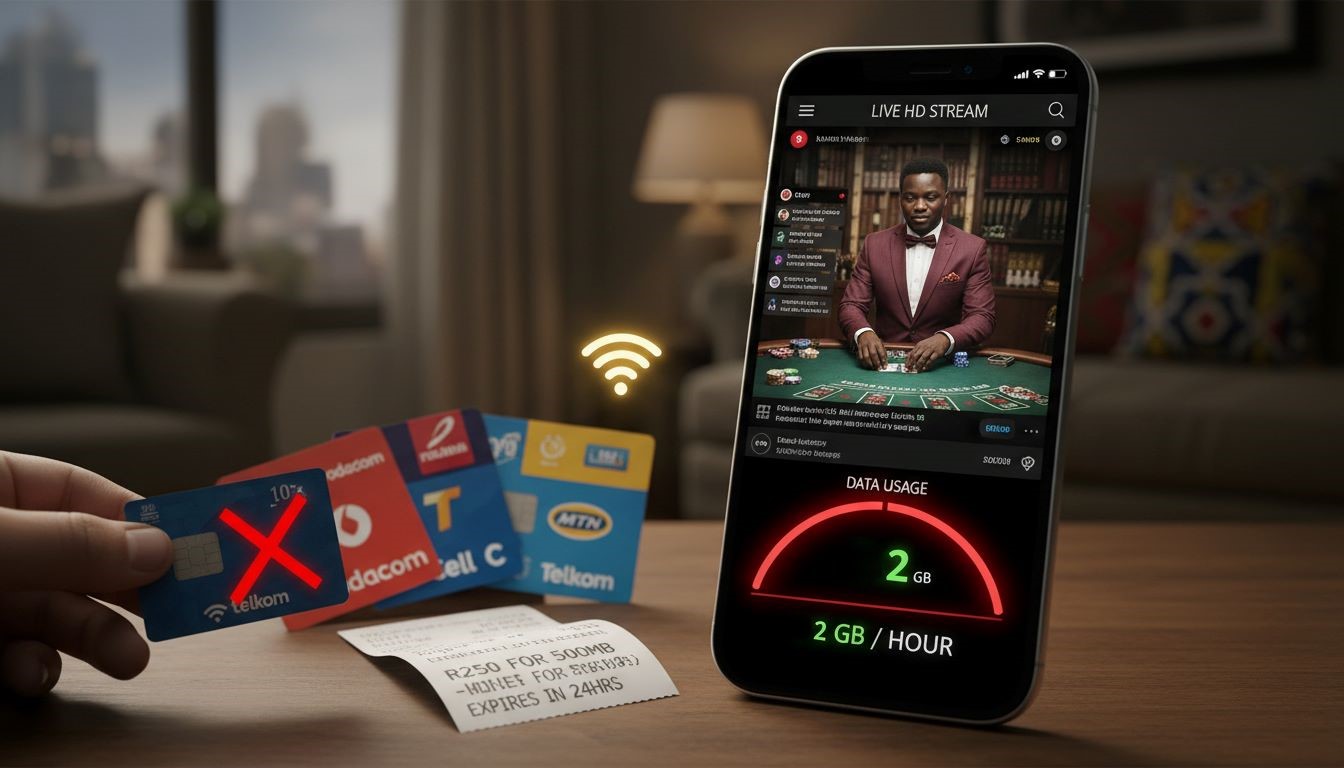
South Africa’s mobile data landscape presents unique challenges for digital entertainment enthusiasts, particularly those interested in live casino gaming. The intersection of high data costs and data-intensive streaming creates a complex economic reality that affects how South Africans engage with online entertainment platforms.
Understanding the relationship between mobile data expenses and live casino streaming is crucial for players who want to enjoy their favorite games while managing their budgets effectively. The cost implications extend beyond simple entertainment spending, touching on broader issues of digital accessibility and economic priorities in emerging markets.
South African Data Costs
In South Africa, a prepaid 1 GB bundle is often quoted at around R80–R90, which for low-income workers can equate to several hours of work at the minimum wage. While prices have come down since the late 2010s and have been stable since 2022, data remains expensive relative to earnings, limiting digital inclusion in poorer and rural households.
Historical Price Trends and Market Dynamics
The South African telecommunications market has experienced significant shifts over the past decade, with regulatory pressure and increased competition driving gradual price reductions. However, the country still ranks among the more expensive markets globally when data costs are measured against average income levels. Network operators have introduced various bundle options and promotional packages, but the fundamental challenge of affordability persists for many consumers.
Income-to-Data Cost Ratios
For workers earning minimum wage, purchasing a single gigabyte of data represents a substantial portion of their daily earnings. This economic reality forces consumers to make difficult choices about how they allocate their data usage, often prioritizing communication and essential services over entertainment applications. The disparity between urban and rural access further complicates the landscape, with rural users often facing even higher effective costs due to network infrastructure limitations.
Data Usage for Live Casino Streaming
Live casino platforms use HD or near-HD video with real-time interaction. Depending on quality (720p vs 1080p), a player can use 1–3 GB of data in a few hours of continuous live-dealer play. A single long session may consume data worth a notable share of a day’s wage for low-income users.
Technical Requirements and Consumption Patterns
| Stream Quality | Data per Hour | Cost per Hour (R80/GB) | 3-Hour Session Cost |
|---|---|---|---|
| 480p Standard | 300-500 MB | R24-R40 | R72-R120 |
| 720p HD | 700 MB-1.2 GB | R56-R96 | R168-R288 |
| 1080p Full HD | 1.5-2.5 GB | R120-R200 | R360-R600 |
The interactive nature of live casino games requires consistent, high-quality video streams to maintain the authentic casino experience. Multiple camera angles, dealer interactions, and real-time game mechanics all contribute to increased bandwidth requirements compared to standard video streaming services.
Affordability Trade-offs
In parts of Sub-Saharan Africa, mobile data costs can consume several percent of a monthly income. This puts entertainment uses like live casino streaming in competition with essentials such as messaging for work, education, or job-hunting. Frequent or extended streaming sessions can be financially risky for users on prepaid mobile plans.
Economic Impact on Digital Entertainment Access
The high cost of data relative to income creates a digital divide that extends beyond simple connectivity issues. Many South Africans must choose between using their data allowances for entertainment purposes or reserving them for more critical activities such as job searching, educational content, or maintaining professional communications. This economic pressure significantly impacts how consumers engage with digital entertainment platforms.
Budget Allocation Challenges
For households operating on tight budgets, recreational data usage represents a luxury that may be difficult to justify. The immediate cost of a live casino streaming session can equal or exceed other daily necessities, forcing users to carefully consider the value proposition of their entertainment choices. This creates a barrier to consistent engagement with live casino platforms and may limit the growth of the digital gaming market in the region.
Practical Ways to Limit Costs
Users can reduce data costs by using uncapped or cheaper fixed broadband or public Wi-Fi, lowering video stream quality, shortening session durations, or avoiding multiple tables. Choosing platforms optimized for mobile with lower-bandwidth options can help, but high data prices relative to wages remain a core issue.
Cost-Reduction Strategies
- Utilize public Wi-Fi networks at shopping centers, libraries, or restaurants when available
- Reduce video quality settings to 480p or lower to minimize data consumption
- Set time limits for gaming sessions to maintain budget control
- Focus on single-table play rather than multi-table sessions
- Take advantage of operator promotions and off-peak data packages
- Consider fixed broadband options where available and affordable
- Use data monitoring apps to track consumption in real-time
Platform Selection and Optimization
Choosing live casino platforms that offer mobile-optimized experiences can significantly reduce data consumption without severely compromising the gaming experience. Some operators provide adaptive streaming technology that automatically adjusts video quality based on connection strength and data usage preferences. Players should also look for platforms that offer preview modes or demo versions that consume less data while allowing them to familiarize themselves with games before committing to full sessions.
The relationship between South African mobile data costs and live casino streaming remains a significant challenge for many consumers. While technological improvements and increased competition may gradually improve affordability, players must currently navigate careful budget management to enjoy live casino entertainment responsibly within their financial means.